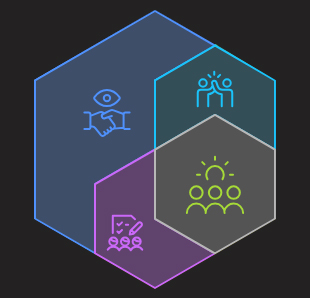
 Business to Business |
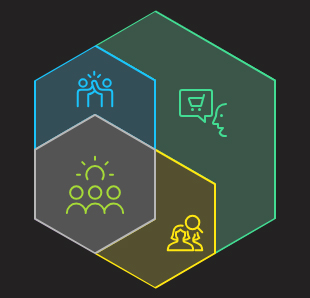 Business to Consumer |
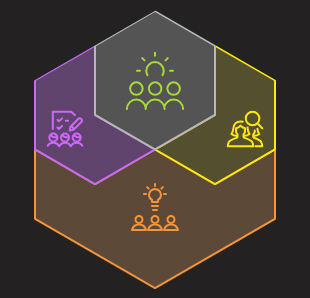 Design and Research |
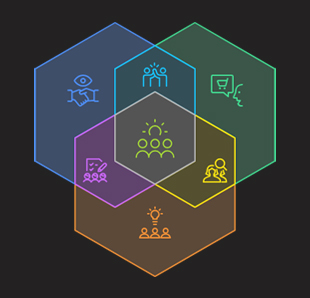 Bringing it all together |
|
Business to Business |
Business to Consumer |
Design and Research |
Bringing it all together |
Where I Start: Research and Discovery
Every project begins with understanding — not assumptions. Before a single wireframe is drawn, I invest in learning the people who will use the product: their goals, behaviors, mental models, and pain points. This means user interviews, contextual inquiry, surveys, and behavioral analysis, conducted in person or remotely depending on the engagement.
From that research I develop detailed user personas and map the full user journey — identifying where friction lives, where opportunities exist, and where business goals and user needs intersect. This foundation shapes every decision that follows.
AI-Assisted Design
Most UX practitioners have experimented with AI tools. Far fewer have built structured workflows around them. The difference is significant — ad hoc AI use produces inconsistent output that requires heavy cleanup and rarely survives contact with a real design system. Systematic AI use compresses iteration cycles without sacrificing quality.
I architect the infrastructure that makes AI output actually usable: structured requirements frameworks, prompt guardrails with brand and interaction constraints, and Figma Make workflows that generate layout variations and component states that are on-brand and production-ready from the first pass. The AI handles the iteration. The design judgment stays human.
In practice, this means a recent engagement that involved defining role-based workflows for a mortgage-operations SaaS portal — then feeding that same requirements framework directly into Figma Make to accelerate wireframe-to-prototype cycles while keeping every screen consistent with the design system. What would have taken multiple rounds of manual iteration was compressed into a single structured pass.
The approach extends to research as well: AI-generated user personas built from structured interview data, giving product teams a richer and more actionable picture of their users than traditional deliverables alone. This is where the practice is going. I’m already there.
How I Work: B2B vs. B2C
Enterprise and SaaS products — the B2B environments I work in most frequently — present a specific kind of design challenge. The users are often specialists: loan officers, underwriters, data analysts, operations managers. The workflows are complex, the data is dense, and the margin for error is low. My approach here prioritizes role-based architecture, clear information hierarchy, and reducing cognitive load without oversimplifying the task.
Consumer-facing products demand a different lens — one focused on emotional resonance, conversion, and reducing drop-off at every step. I’ve driven measurable results in both environments, including a 15% conversion lift on an e-commerce platform and a 25% boost in customer satisfaction scores on a redesigned consumer portal.
Architecture and Design
Once research is synthesized, I move into information architecture — defining taxonomies, task flows, sitemaps, and role-based workflows before touching visual design. Getting the structure right early prevents expensive rework later and gives engineering a clear foundation to build from.
From there I work through wireframes iteratively — starting low-fidelity to validate structure and flows quickly, then moving to high-fidelity interactive prototypes in Figma that closely mirror the final product. These prototypes are the primary vehicle for stakeholder alignment, usability testing, and engineering handoff.
Testing, Iteration, and Refinement
Prototypes are hypotheses. I treat every design as something to be tested, not presented. Usability testing — moderated or unmoderated, in-person or remote — surfaces issues that even the best research can’t fully anticipate. Findings feed directly back into the design, driving another cycle of refinement until the product is genuinely intuitive.
This iterative loop is where the real work happens. It’s also where I’ve consistently delivered measurable outcomes: reduced error rates, faster task completion, higher engagement, and lower training time for new users.
Bringing It All Together
The best UX work is invisible — users simply accomplish what they came to do without friction or confusion. Getting there requires equal parts research rigor, design craft, technical fluency, and the ability to align stakeholders around a shared vision.
That’s what I bring to every engagement — whether I’m the sole UX practitioner on a startup product or embedded in a cross-functional team at a large enterprise.